
Cost of Knowing Too Much
Suppose a client retrieves an order:
GET /api/orders/8e2f3a91-6d47-4c8b-9e13-2a7b5c0d4f62
{
  "status": "placed",
  "totalPrice": 149.00
}
We know the order’s state. But can we cancel it? Pay for it? Where are its items? What request performs each operation?
A conventional client learns these details from documentation, an OpenAPI description, or a generated SDK. Its application code might look like this:
Order order = api.getOrder(orderId);

if (order.status() == PLACED) {
    api.cancelOrder(orderId);
}
This client embeds an eligibility assumption: an order in the placed state can be cancelled. It also relies on a predefined operation for submitting the cancellation request. Suppose the business introduces a cancellation deadline: orders may now be cancelled only within 30 minutes of placement. The client-side condition is wrong, and consumers that copied the rule need attention.
A server-computed canCancel property solves that problem without hypermedia:
Order order = api.getOrder(orderId);

if (order.canCancel()) {
    api.cancelOrder(orderId);
}
The server now owns the eligibility rule. But the client still needs to know how to invoke cancellation.
In a typical OpenAPI-generated SDK, cancelOrder() is bound to a predefined HTTP method, URI template, and request
contract. Those details are hidden from application code, but they remain part of the deployed client.
If the server removes or incompatibly changes the operation, consumers must update their SDKs or rely on a compatibility mechanism. Updating the SDK may leave application code unchanged, but consumers still need to adopt, test, and deploy it.
The limitation is not inherent to generated code. An SDK can expose strongly typed operations while resolving invocation details at runtime. The distinction is whether those details are embedded in the client or obtained from the server.
Across many independently deployed consumers, even a small change can introduce coordination and compatibility costs.
Hypermedia offers another option: communicate available interactions and their invocation details through resource representations, allowing clients to discover them at runtime.
Shared Understanding: Design Time and Runtime
Every API requires a shared contract. Clients must understand the data they receive, the meaning of the operations they perform, and the conventions used to communicate with the server.
In a typical operation-oriented client, invocation details are established before execution. A hypermedia-aware client can instead resolve supported interaction details from resource representations at runtime.
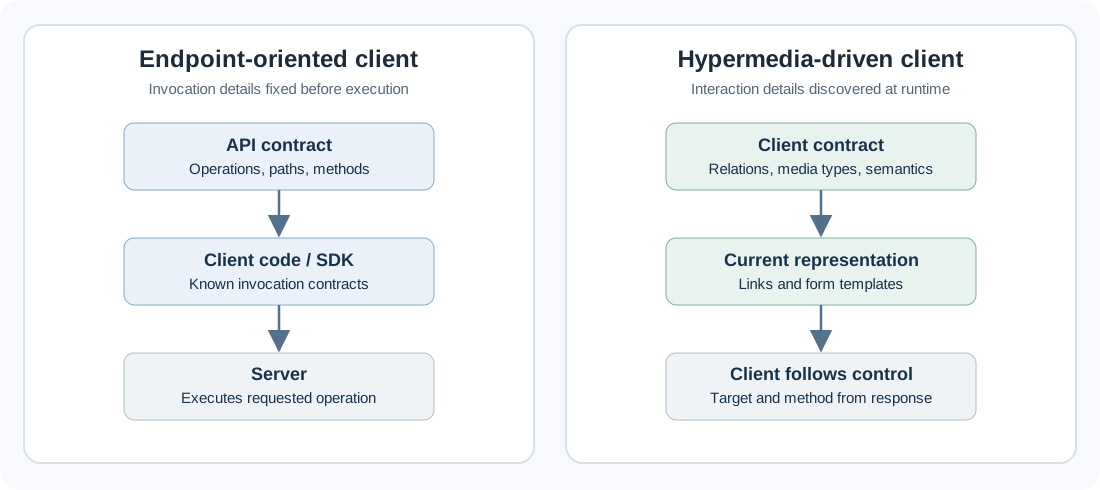
Clients with predefined invocation contracts bind request details before execution. Hypermedia-aware clients can discover interaction targets and submission details at runtime. Both approaches still require shared semantics.
OpenAPI provides a mature foundation for describing operations and schemas, generating strongly typed clients, and validating integrations before deployment.
HAL and HAL-FORMS serve a different purpose. They standardize how links and submission controls are represented, but do not provide an equivalent, complete API description from which conventional typed clients can be generated.
The two approaches can be combined. An API might use OpenAPI to document its domain models and supported interactions, while using hypermedia to communicate which interactions are currently available and how to invoke them.
A client can retain generated domain models and strongly typed operations while resolving targets and submission details dynamically.
The distinction is between what the client must understand in advance and what the server communicates at runtime.
From Resource State to Available Interactions
A resource representation normally describes the resource’s current state. With hypermedia, it can also communicate the interactions currently available.
In the Order System, an order in the placed state can advertise links such as:
{
  "status": "placed",
  "totalPrice": 149.00,
  "_links": {
    "self": {
      "href": "/api/orders/8e2f3a91-6d47-4c8b-9e13-2a7b5c0d4f62"
    },
    "os:items": {
      "href": "/api/orders/8e2f3a91-6d47-4c8b-9e13-2a7b5c0d4f62/items"
    },
    "os:cancel": {
      "href": "/api/orders/8e2f3a91-6d47-4c8b-9e13-2a7b5c0d4f62/cancel"
    },
    "os:pay": {
      "href": "/api/orders/8e2f3a91-6d47-4c8b-9e13-2a7b5c0d4f62/payments"
    }
  }
}
This abbreviated HAL representation contains resource data and links to related resources. The os:cancel and os:pay
relations identify interactions offered for this order. The os: prefix is a HAL CURIE prefix, expanded through a relation
URI template omitted here for brevity.
The client does not have to infer cancellation eligibility from status == placed. It can inspect whether the cancellation
interaction is advertised.
A HAL link alone, however, does not specify the HTTP method or request body required for a state-changing operation.
With Accept: application/prs.hal-forms+json, the server can additionally provide a HAL-FORMS template:
{
  "_templates": {
    "cancel": {
      "method": "POST",
      "target": "/api/orders/8e2f3a91-6d47-4c8b-9e13-2a7b5c0d4f62/cancel",
      "properties": []
    }
  }
}
The client can obtain the submission details from the template rather than constructing the request itself.
The template name and link relation are distinct identifiers. A client needs a documented convention for selecting the appropriate template; matching their names is not a general HAL-FORMS rule.
Resource State and Application State
The order’s status is part of its resource state, which the server manages. A representation exposes selected information
about that state.
Application state concerns the client’s progression through interactions with the application. The client maintains that state, while representations provide hypermedia controls that guide its next steps.
For example, a client viewing a placed order can follow os:items to inspect its items, then navigate back to the order.
The client has progressed through the application, but the order can remain placed throughout.
Following os:items changes the client’s navigation state without modifying the order. Submitting the cancellation form
instead requests a resource-state change, which the server may accept or reject.
The order’s lifecycle can be modeled as a finite-state machine. That is a server-managed resource lifecycle, not the client’s application state machine.
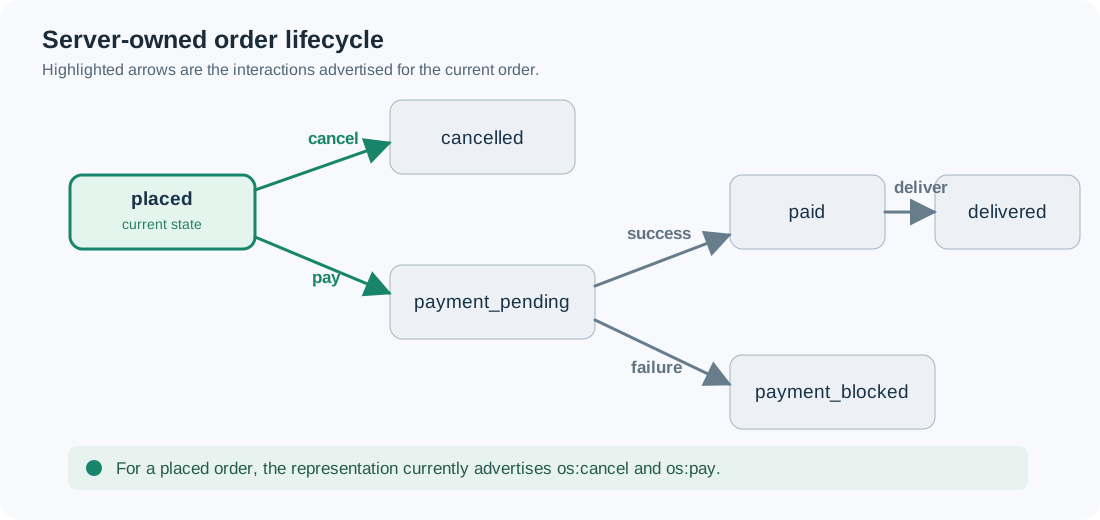
The server governs the order lifecycle. For a placed order, the representation advertises os:cancel and os:pay.
Following os:items changes the client’s navigation state without changing the order’s lifecycle state. The diagram
simplifies payment outcomes and other workflow details.
A client can navigate through the application without reproducing every transition in the server’s resource lifecycle.
Discoverability Is a Form of Decoupling
Starting from an API entry point, a client can follow named relationships and inspect the interactions offered by each representation.
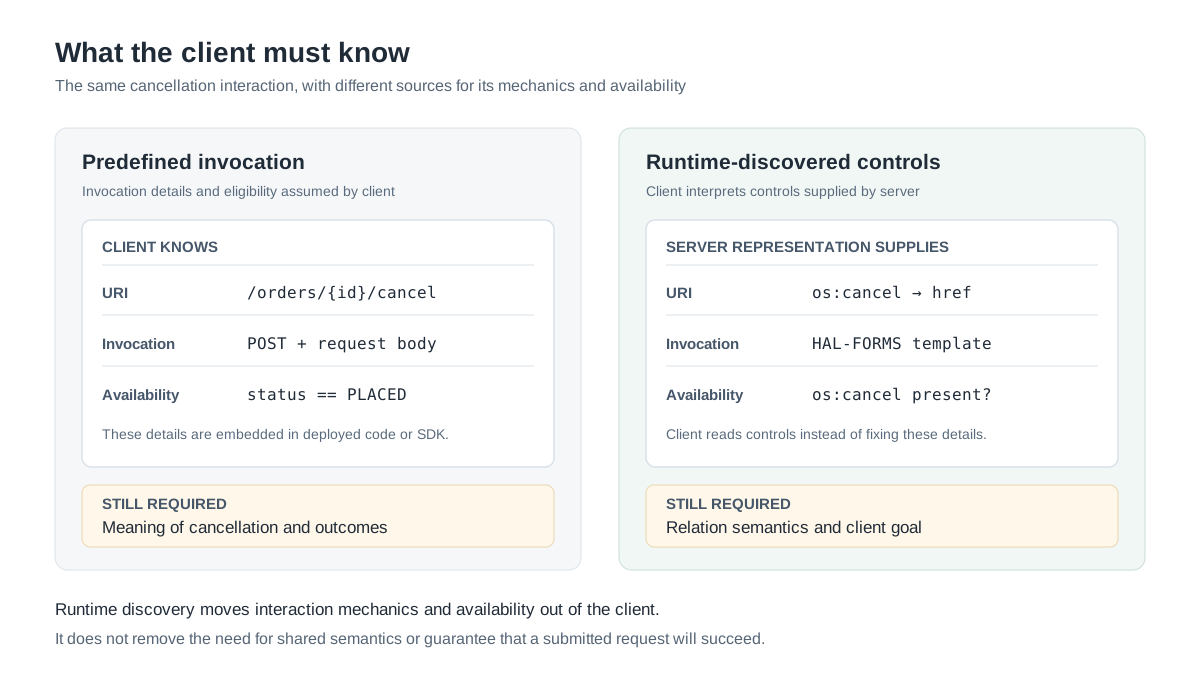
Information discovered at runtime does not have to be embedded in every client. The degree of decoupling depends on which details the server provides and which the client actually uses.
URI Coupling
A client following os:cancel does not need to construct or hardcode the cancellation URI.
Suppose the Order System changes its cancellation endpoint:
Before:
POST /api/orders/{id}/cancel

After:
POST /api/orders/{id}/cancellation
The operation still has the same meaning and accepts the same inputs. Only its URI has changed.
Clients with /cancel embedded in their invocation logic continue working while the old endpoint remains supported. If
the server removes it, those clients must update or rely on a compatibility mechanism.
This applies to handwritten clients and generated SDKs with fixed URI templates.
A client that discovers the cancellation target from the current representation can use /cancellation without changing
its code, provided it reaches the order through a stable entry point or previously discovered link.
Invocation Coupling
URI independence does not imply independence from invocation details.
A client might discover os:cancel but still assume cancellation requires a POST request with a particular body.
HAL-FORMS can reduce this dependency by describing the submission method, target, and input properties at runtime.
There are limits. If the server adds a mandatory cancellation reason, a generic interactive client might render the new field and collect a value. An automated client cannot necessarily determine which reason is appropriate.
Likewise, changing an HTTP method may affect semantics. A client must support the method and understand the interaction it performs.
Workflow Coupling
A client may know how to invoke every operation but still assume the server follows a particular sequence of states and transitions.
It might assume that an order can always be paid when its status is placed, for example.
Advertised controls let the client check which interactions are currently available rather than infer them entirely from resource state.
This does not tell the client which interaction advances its goal, whether an unavailable interaction might become available later, or how to recover when no suitable interaction is offered.
Those decisions remain part of the client’s application logic.
What Remains Coupled?
A client following os:cancel still depends on the meaning of cancellation, the expected outcomes, and the conventions
used to interpret the representation.
It need not know the cancellation URI in advance. With suitable HAL-FORMS processing, it can also discover supported submission details.
Hypermedia therefore reduces coupling to server-controlled interaction mechanics and availability, not to the shared meaning of interactions or the client’s business requirements.
Evolving Workflows Without Rewriting Clients
Consider a client that embeds part of the server’s payment workflow:
switch (order.status()) {
    case PLACED -> api.pay(orderId);
    case PAYMENT_PENDING -> api.checkPayment(orderId);
    case PAYMENT_BLOCKED -> handlePaymentFailure(order);
    default -> handleUnexpectedState(order);
}
The client associates particular resource states with predefined operations.
Initially, the payment workflow looks like this:
The client assumes that payment begins in the placed state and that a payment_pending order should be checked until
payment completes or fails.
Now suppose the server no longer offers payment immediately for every placed order. The order may remain placed while
the server determines whether payment can proceed. Once payment becomes available, the representation advertises os:pay.
This is a hypothetical change to the Order System’s payment workflow, not a claim about its current implementation.
The interaction has not changed, but its availability has. A client relying on PLACED -> pay may attempt payment prematurely.
But what happens when os:pay is absent?
The client may need to refresh the representation, follow another advertised interaction, report that payment is unavailable, or stop processing. Which behavior is appropriate depends on the application’s goal and contract.
Hypermedia communicates interaction availability. It does not automatically provide a waiting or recovery strategy.
The distinction becomes important when workflows evolve. Changing the availability or ordering of known interactions can be compatible with existing clients. Introducing a mandatory interaction with unfamiliar semantics may require new client logic, even if the server advertises it through hypermedia.
Couldn’t OpenAPI Do the Same?
Yes. A conventional API can expose capability flags or available actions:
{
  "status": "placed",
  "availableActions": [
    "pay"
  ]
}
OpenAPI does not prevent an API from exposing available actions, interaction targets, or submission metadata. HAL and HAL-FORMS provide established conventions for representing those controls.
The distinction is not OpenAPI versus hypermedia, but how much of the interaction contract remains fixed in the client.
The Economics of Independent Evolution
Removing the old /cancel endpoint requires clients with that URI embedded in their invocation logic to
update. Clients resolving the target dynamically can continue using the new URI without modification.
Preserving the old endpoint may still be cheaper than introducing hypermedia. Endpoint renaming alone is not a compelling reason to adopt it.
The more interesting case is an API with many independently maintained consumers and interactions that evolve over time. Compatible changes to interaction targets, submission mechanics, or the availability of known operations can sometimes be made without coordinating consumer releases.
Compatibility depends on the client’s existing capabilities, not merely on what the server advertises.
The economic benefit depends on the frequency of those changes, the number of affected consumers, and the cost of coordinating their releases.
The Cost of Runtime Flexibility
Runtime discovery shifts some responsibilities from design time to execution. Clients must understand HAL and HAL-FORMS processing conventions, while domain-specific relation semantics still need documentation.
There are testing implications too.
A client that discovers controls dynamically must be tested against representations with different combinations of available interactions, including missing, unfamiliar, and changing controls.
Some mistakes that predefined operations might expose during compilation or contract testing may instead surface when a particular runtime interaction is encountered.
A practical design can combine generated models and strongly typed application interfaces with runtime-discovered interaction targets and submission details.
The additional flexibility must justify the additional client infrastructure.
For a small API with stable operations and easily updated consumers, predefined invocation contracts may be simpler. For a long-lived API with independently deployed consumers, reducing coordinated client releases may justify the investment.
It Takes Two to Tango
Hypermedia only reduces coupling when clients actually follow the controls the server provides.
A server can return HAL links and HAL-FORMS templates, but clients that ignore them remain dependent on their predefined request targets and workflow assumptions.
Following the controls also does not guarantee that an interaction will succeed. Suppose a client retrieves a placed
order and sees os:cancel. Before it submits the cancellation form, another request changes the order so that
cancellation is no longer permitted.
The client submits the previously advertised request:
POST /api/orders/8e2f3a91-6d47-4c8b-9e13-2a7b5c0d4f62/cancel
The server may respond:
HTTP/1.1 409 Conflict
The client followed the advertised interaction correctly, but the server rejected the request because cancellation was no longer permitted. The client may need to retrieve the current representation before deciding what to do next.
The server must enforce authorization and revalidate business rules when processing the request. An advertised control is therefore not an authorization or execution guarantee.
Hypermedia does not eliminate concurrency problems, retries, or network failures. It changes how clients discover and invoke interactions, not the guarantees required to execute them safely.