
Most APIs described as RESTful expose resources through HTTP, use familiar methods such as GET, POST, PUT, and DELETE, and return JSON representations. OpenAPI specifications document the available operations, while generated clients make them straightforward to invoke.
This approach works well for many applications. But it raises an architectural question worth examining:
How much does a client need to know about the server to interact with it?
Consider an order management API. A client can create an order, retrieve it, pay for it, cancel it, or mark it as delivered.
A generated Java client might expose methods such as:
api.createOrder(request);
api.getOrder(orderId);
api.payOrder(orderId);
api.cancelOrder(orderId);
api.deliverOrder(orderId);
These methods provide a convenient, type-safe way to invoke operations. They also rely on predefined knowledge of the API’s operations and how to invoke them.
For example, an order might be cancellable only before payment. A client could determine eligibility from the order’s status, but that introduces a dependency on the server’s business rules.
The server could instead communicate eligibility directly:
{
  "status": "placed",
  "canCancel": true
}
This keeps the decision on the server. However, the client still needs to know which API operation performs cancellation and how to invoke it.
What if the server could communicate both available interactions and their invocation details through a standardized mechanism?
Discovering and submitting an order
with products=1 C->>S: GET /api/orders/form?products=1
(Accept: application/prs.hal-forms+json) S-->>C: HAL-FORMS with createOrder template Note over C: Extract application data
and supply Idempotency-Key
(required by API contract) C->>S: POST template.target
(Content-Type: application/json) S-->>C: 201 Created + Location
The Order System is a small example application built with Spring Boot and Spring HATEOAS. It uses HAL to describe resource relationships and HAL-FORMS to describe available operations.
Rather than requiring clients to know the order submission endpoint in advance, the API exposes an entry point from which resources and interactions can be discovered.
Discovering the order form
A client begins by requesting the API root:
curl -i http://localhost:8090/ \
  -H 'Accept: application/hal+json'
The response advertises an order form through the os:orders-form relation:
{
  "_links": {
    "os:orders-form": {
      "href": "http://localhost:8090/api/orders/form{?products}",
      "templated": true,
      "title": "Purchase order form"
    },
    "curies": [
      {
        "name": "os",
        "href": "https://order-system.cloudneutral.se/rels/{rel}",
        "templated": true
      }
    ]
  }
}
The example omits unrelated links.
The os prefix is a CURIE, a compact URI used to identify application-specific link relations. It expands to a URI
identifying the relation independently of the server’s deployment location.
The os:orders-form link is also a URI template. Its products parameter determines how many product lines the generated
form should contain.
A client requesting a form with one product line follows the expanded URI:
curl -i 'http://localhost:8090/api/orders/form?products=1' \
  -H 'Accept: application/prs.hal-forms+json'
Notice that the client discovers the form’s location rather than constructing its path.
Submitting the form
The server returns an order form containing initial values and a HAL-FORMS template describing how to submit it.
The following excerpt shows the relevant properties:
{
  "customerId": "0ce7d95f-437b-46ad-8fb1-b1378d8881a0",
  "items": [
    {
      "productId": "56b95a51-8227-489f-b5e6-834a2ffb849f",
      "quantity": 2
    }
  ],
  "_links": {
    "describedby": {
      "href": "http://localhost:8090/profiles/order-request"
    }
  },
  "_templates": {
    "createOrder": {
      "method": "POST",
      "contentType": "application/json",
      "properties": [
        {
          "name": "customerId",
          "required": true
        },
        {
          "name": "items",
          "required": true
        }
      ],
      "target": "http://localhost:8090/api/orders"
    }
  }
}
The template describes the HTTP method, submission target, content type, and expected properties.
The actual representation provides additional metadata, including constraints on customerId and a link for discovering
available customer selections.
The describedby relation identifies a JSON Schema that describes the request structure and its constraints.
Using the method, content type, and target advertised by the HAL-FORMS template, the client can submit the form’s application data:
curl -i -X POST 'http://localhost:8090/api/orders' \
  -H 'Content-Type: application/json' \
  -H 'Accept: application/hal+json' \
  -H 'Idempotency-Key: example-order-001' \
  -d '{
    "customerId": "0ce7d95f-437b-46ad-8fb1-b1378d8881a0",
    "items": [
      {
        "productId": "56b95a51-8227-489f-b5e6-834a2ffb849f",
        "quantity": 2
      }
    ]
  }'
The client submits the application data, not the entire HAL-FORMS representation.
The Order System also requires an Idempotency-Key header when placing an order. Reusing the same key for retries allows
the server to recognize repeated submissions of the same logical request rather than create duplicate orders.
This requirement is part of the API contract but isn’t currently described by the HAL-FORMS template. The client must obtain that knowledge separately.
A successful submission returns 201 Created, with a Location header identifying the new order resource.
The client can then retrieve the created order or follow the links provided in its representation.
Discovering available operations
Creating an order is only the beginning of the interaction.
The server returns a HAL representation describing the newly created resource and its relationships.
For example:
HTTP/1.1 201 Created
Content-Type: application/hal+json
Location: http://localhost:8090/api/orders/5f213cd7-ce00-4338-9520-9fadc1267224
{
  "status": "placed",
  "totalPrice": 166360.14,
  "_links": {
    "self": {
      "href": "http://localhost:8090/api/orders/5f213cd7-ce00-4338-9520-9fadc1267224"
    },
    "os:items": {
      "href": "http://localhost:8090/api/orders/5f213cd7-ce00-4338-9520-9fadc1267224/items"
    },
    "os:cancel": {
      "href": "http://localhost:8090/api/orders/5f213cd7-ce00-4338-9520-9fadc1267224/cancel"
    },
    "os:pay": {
      "href": "http://localhost:8090/api/orders/5f213cd7-ce00-4338-9520-9fadc1267224/payments"
    }
  }
}
The example omits unrelated properties and links.
The self relation identifies the order resource, while os:items identifies its line-item collection.
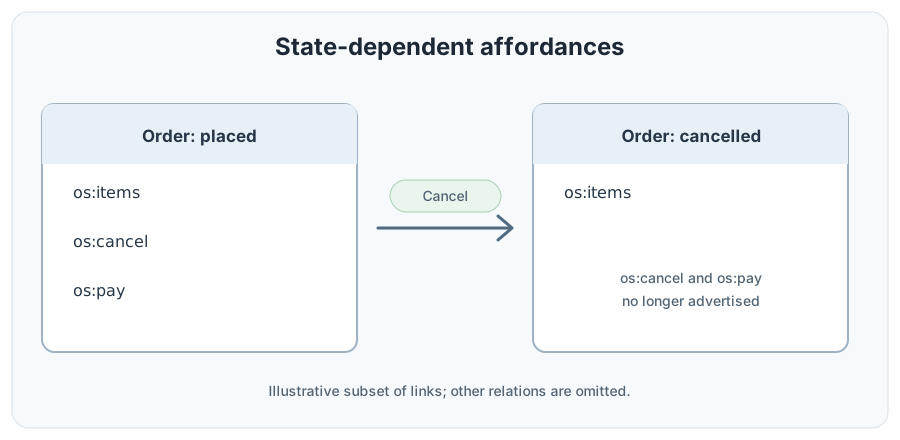
The os:cancel and os:pay relations identify interactions currently available for the order.
In this API, the server advertises these relations according to the order’s current state. This is an application-level convention, not behavior enforced automatically by HAL.
State-dependent affordances
Suppose the client wants to cancel the order.
The presence of os:cancel tells it that cancellation is currently available, without requiring it to reproduce the
server’s eligibility rules.
However, a HAL link alone doesn’t specify the HTTP method or request content required to perform the operation.
The client can request the order using HAL-FORMS:
curl -i 'http://localhost:8090/api/orders/5f213cd7-ce00-4338-9520-9fadc1267224' \
  -H 'Accept: application/prs.hal-forms+json'
The representation includes a cancellation template:
{
  "_templates": {
    "cancel": {
      "method": "POST",
      "properties": [],
      "target": "http://localhost:8090/api/orders/5f213cd7-ce00-4338-9520-9fadc1267224/cancel"
    }
  }
}
The client now has the information needed to invoke cancellation. The empty properties array indicates that the
operation requires no input properties.
There is a distinction between the os:cancel link relation and the "cancel" template key. HAL-FORMS does not
automatically associate the two identifiers. A client needs an API-specific convention to determine which template
corresponds to the advertised interaction.
Once the order is cancelled, the server no longer advertises the cancellation affordance.
The same principle applies to other state-dependent operations. Their availability is determined by the server and communicated through the resource representation.
An advertised operation isn’t a guarantee of success. State can change between retrieving the representation and invoking the operation, so the server must still validate the request.
REST’s uniform interface
The workflow illustrates hypermedia as the engine of application state, commonly abbreviated HATEOAS.
Hypermedia is one of REST’s defining architectural constraints, although it is frequently absent from APIs described as RESTful.
REST’s uniform interface encompasses resource identification, manipulation through representations, self-descriptive messages, and hypermedia-driven application state.
The last of these changes how clients interact with servers.
Rather than relying entirely on predefined endpoint knowledge, clients discover available interactions through resource representations.
In the Order System, the client discovers the order form, submits it using an advertised template, follows the resulting resource, and discovers the operations available in its current state.
Why standardized controls matter
A server can communicate available operations without using hypermedia. A conventional API might expose canCancel
or allowedActions, leaving the client to map those capabilities to predefined HTTP requests.
HAL-FORMS provides a standardized representation for describing how an operation can be invoked, including its method, target, and input properties.
A reusable client component can interpret these controls and construct requests without knowing the target URI in advance. The application still needs to understand the operation’s meaning and decide whether to invoke it.
Hypermedia doesn’t eliminate coupling. It provides a way to separate domain semantics from interaction mechanics.
This doesn’t make OpenAPI or generated clients obsolete. OpenAPI describes API contracts and supports documentation, validation, and code generation. HAL and HAL-FORMS provide controls within resource representations at runtime.
The two approaches can coexist.
What hypermedia doesn’t solve
An automated client isn’t a web browser.
A browser can display an unfamiliar form and rely on a human to interpret it. An automated application cannot generally understand an unfamiliar business operation simply because the server advertises it.
The Order System illustrates some of the remaining dependencies. Clients need to understand application-specific link
relations and template conventions. They must also know about requirements not expressed in the representation, such
as the Idempotency-Key header used when creating orders.
And although the server advertises operations according to the resource’s current state, that state can change before a client submits its request.
A client might retrieve an order with an os:cancel link, only for another request to change the order’s state before
cancellation is submitted. The server must evaluate the cancellation rules again rather than treating the previously
advertised link as authorization to proceed.